
Life throws difficult periods at everyone. Work pressures, family responsibilities, financial worries, health concerns and major life changes can all take their toll. In many cases, these feelings pass with time, rest or support from friends and loved ones.
But sometimes, they don’t.
Knowing when to seek professional help can make a significant difference to both short- and long-term wellbeing. Mental health difficulties do not discriminate. They affect people from every background, profession and walk of life. And the research makes clear just how common they are.
Mental Health Difficulties Are Far More Common Than You Think
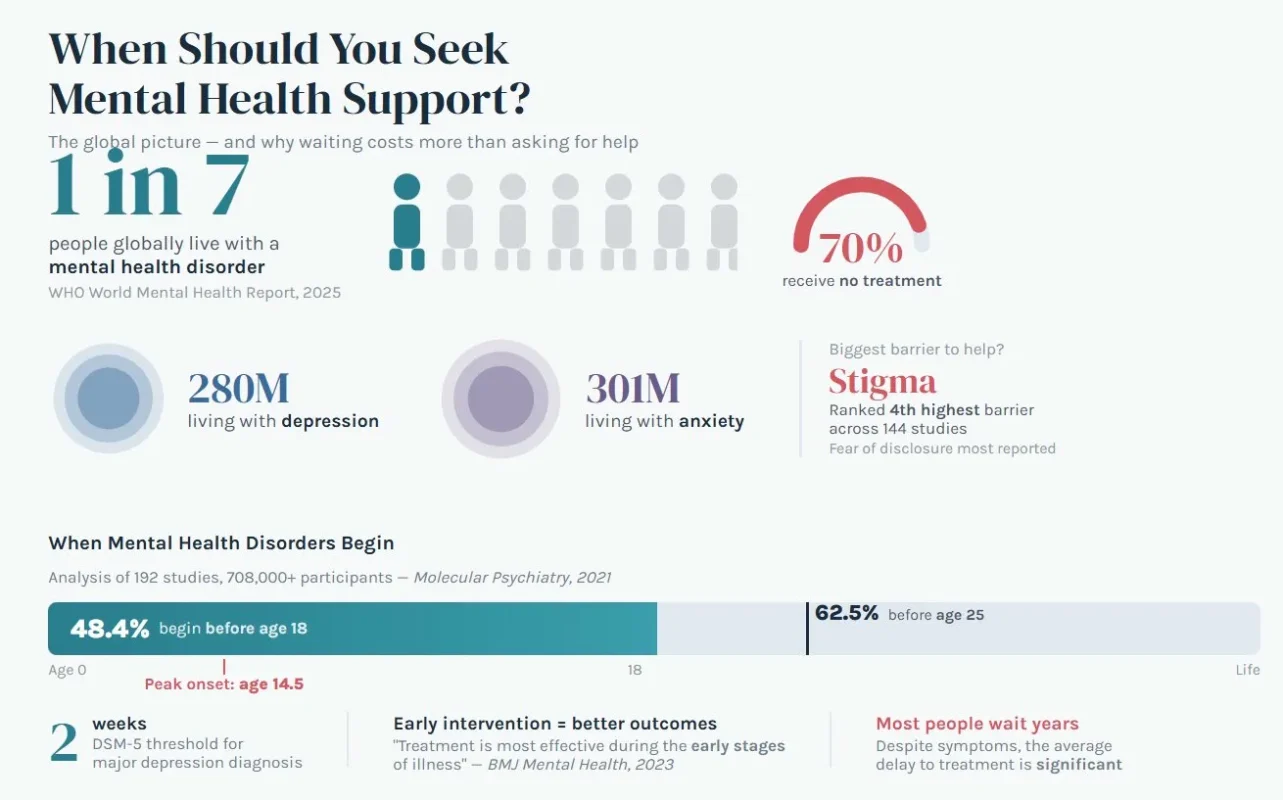
The World Health Organization report, World Mental Health Today (September 2025) indicates that over one billion individuals in the world today live with a mental health disorder. That is one out of seven individuals in the world.
The most prevalent ones are anxiety and depression. Approximately 280 million people in the world are affected by depression whereas anxiety disorders affects approximately 301 million individuals. These are not uncommon disorders of other people. They are common, curable and nothing to be shameful.
In Molecular Psychiatry, a large-scale meta-analysis was conducted and examined 192 epidemiological studies involving more than 708,000 participants. The results were dramatic: almost half (48.4%) of all lifetime mental disorders onset before the age of 18, and 62.5 before the age of 25. The highest prevalence age of all mental disorders was 14.5 years (Solmi et al., “Age at onset of mental disorders worldwide,” 2021).
This study emphasises on something of importance. Mental health problems tend to develop at a tender age and once not tackled they may take root at an old age.
Why We Hesitate to Seek Help
Although a good number of individuals experience mental health conditions, they take years to consult a professional. A systematic review conducted in Psychological Medicine reviewing 144 studies comprising of more than 90,000 participants determined that stigma produces a consistent negative influence on the help-seeking behaviour. The most prominent barriers were internalized stigma (felt shame or embarrassment) and treatment stigma (felt what seeking help meant about you) (Clement et al., 2015).
The evaluation established that stigma was ranked fourth among the greatest barriers that exist towards mental health care seeking. Some of the stigma-related barriers most frequently reported were disclosure concerns, the concern about being discovered.
In the world over, the majority of individuals with mental illness (more than 70 percent) do not get any treatment by the health care practitioners. This is due to ignorance in knowing where to seek help, fear of discrimination and wrong idea that struggling implies that you have failed in one way or another.
But here’s the reality. The fact that someone requires mental health assistance is not the indication of a weak character or inability to perform. The causes of mental health challenges are both biological and psychological and environmental. It may be caused by genetics, early life events, stress and even physical illness.
The question is not whether you should be able to manage alone. The question is whether continuing to do so is helping or holding you back.
Signs That It May Be Time to Seek Help
Mental health difficulties rarely appear suddenly or dramatically. More often, they build gradually. Some common signs that professional support may be helpful include:
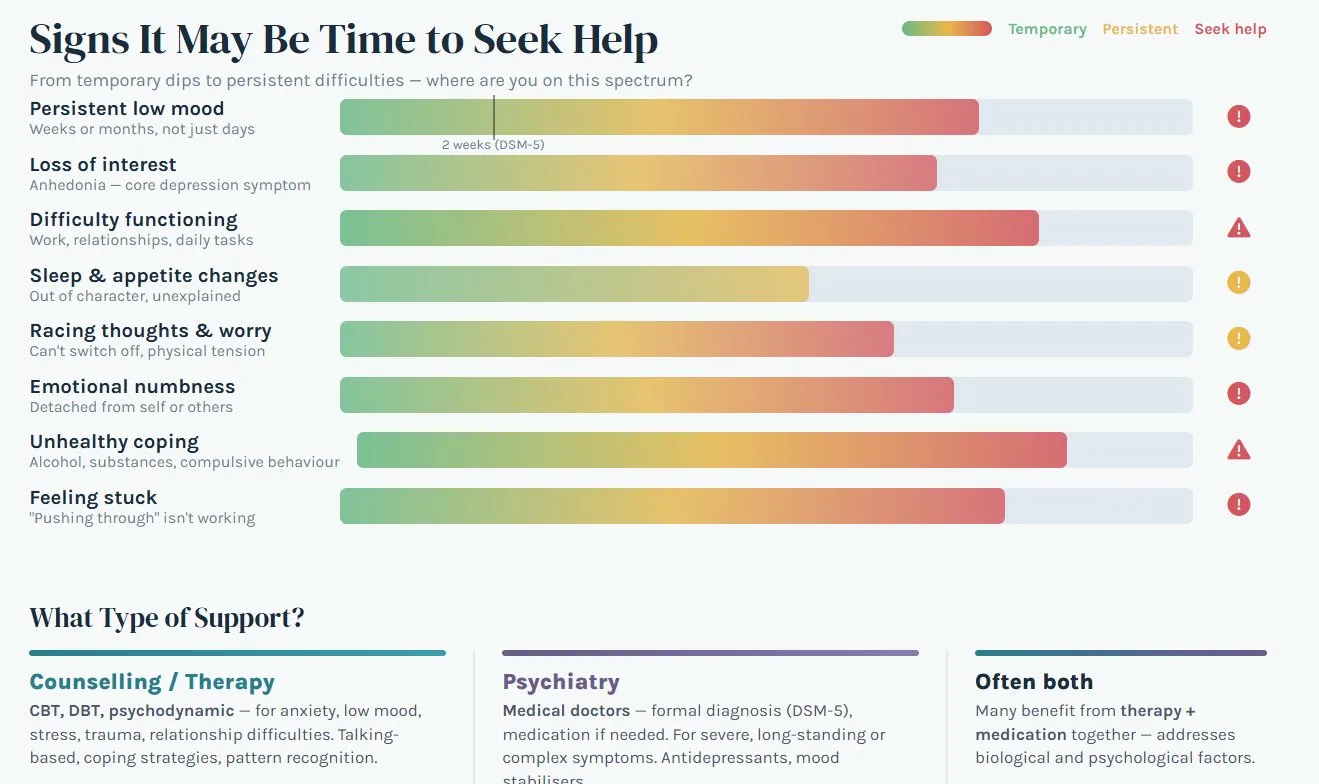
These experiences do not necessarily point to a specific diagnosis. But they can signal that something is happening beneath the surface that deserves attention.
Counselling or Psychiatry: What’s the Difference?
Many people feel unsure about what type of support they need. Counselling and psychiatry serve different but complementary roles.
Counselling or psychotherapy focuses on talking therapies. A therapist, counsellor or psychologist provides a structured space to explore thoughts, emotions and experiences, develop coping strategies and better understand patterns that may be contributing to distress.
Typical methods are cognitive behavioural therapy (CBT), which is aimed at determining and modifying inappropriate thought patterns, and dialectical behaviour therapy (DBT), which is aimed at emotional regulation and toleration of distress. Psychodynamic therapy examines how the past experiences affect the current behaviour.
Anxiety, low mood, stress, relationship problems, bereavement and trauma are some of the issues that can be managed with the help of counselling.
Psychiatry is a medical specialty. Psychiatrists are medical doctors who have completed additional training in mental health. They can assess mental health conditions, make formal diagnoses where appropriate and prescribe medication if needed.
Diagnostic criteria of psychiatrists are based on DSM-5. They can prescribe drugs like antidepressants, mood stabilizers or antipsychotics and will observe the progress over a period of time.
Psychiatry can be beneficial in cases whereby the symptoms are more serious, chronic or have a major impact on the daily functioning. When medication can be part of the treatment is also indicated.
A mixture of the two methods is of beneficence to many people. Medication control with the help of a psychiatrist, and regular meetings with a therapist can offer the level of comprehensive assistance that would not only cover the biological but also the psychological component of mental health.
Why Early Intervention Matters
Research consistently shows that early intervention leads to better outcomes.
A review published in BMJ Mental Health noted that “treatment is most effective during the early stages of illness” and that for depression specifically, “an early intervention approach is the optimal model for care, with some evidence that its full expression can be prevented” (McGorry et al., “Early intervention in youth mental health,” 2023).
The other review articles in the International Journal of Mental Health Systems stated that shortening the period of untreated disease has been strongly demonstrated and has affected the outcome of the first-episode psychosis and schizophrenia positively in numerous aspects. There is an emerging amount of evidence that a similar effect occurs with other psychiatric disorders such as major depressive disorder, bipolar disorder, panic disorder, generalized anxiety disorder and obsessive-compulsive disorder (Catalan et al., 2020).
The feeling of isolation that usually comes with mental health challenges can also be minimized using early support. Talking to a professional gives me insight, confirmation and direction and not criticism.
When you have noticed that your symptoms are protracting, deteriorating, or even starting to cause problems with your work, relationships or health, you can get assistance earlier than later and avoid problems to take root.
When Waiting Is Not the Best Option
It’s common to tell yourself that things will improve on their own. And sometimes they do. But certain warning signs suggest it may be time to act rather than wait:
- Symptoms have lasted more than a few weeks and are not improving. While temporary dips in mood or periods of stress are normal, persistent difficulties warrant attention.
- You’re finding it hard to function in important areas of life. Struggling to get through work, withdrawing from relationships or neglecting self-care are signs that your mental health needs support.
- You’re relying on unhealthy coping mechanisms. Increased alcohol consumption, substance use or other compulsive behaviours suggest underlying distress.
- You’ve had thoughts of self-harm or suicide. If you’re experiencing thoughts about ending your life or hurting yourself, please seek help immediately. These thoughts are a sign that you need urgent support, not evidence that you’re beyond help.
Taking the First Step
If you think you might benefit from mental health support, here are some steps to consider:
- Start with your GP or primary care provider. They can provide an initial assessment, rule out any physical health causes and refer you to appropriate mental health services.
- Consider what type of support you need. If you’re looking for help with coping strategies and emotional processing, a therapist or counsellor may be appropriate. If you’re dealing with severe symptoms or think medication might help, seeing a psychiatrist may be beneficial.
- Check your insurance or healthcare coverage. Understanding what services are covered can help you plan and reduce financial stress.
- Be honest about what you’re experiencing. Mental health professionals are trained to help. The more openly you can describe what you’re going through, the better they can support you.
Accessing support: NHS and private options
In the UK, mental health care is available through the NHS, but waiting times for counselling or psychiatric assessments can sometimes be lengthy. For some people, private care offers faster access, greater flexibility in appointment times, or the ability to choose a specific clinician.
For those exploring private psychiatry in London, clinics like Flint Healthcare can offer timely assessments, personalised care plans and integrated support across psychiatry and counselling, tailored to individual needs and circumstances.
A step towards clarity, not a label
Seeking professional help does not automatically mean receiving a diagnosis or committing to long-term treatment. Often, it is simply a step towards understanding what you’re experiencing and what options are available to you.
Whether support is short-term or ongoing, talking to a trained professional can help you regain a sense of control, clarity and confidence, and remind you that you don’t have to navigate difficult periods alone.
References
- Catalan A, et al. “Prevention and early intervention in youth mental health: is it time for a multidisciplinary and trans-diagnostic model for care?” International Journal of Mental Health Systems. 2020. – https://doi.org/10.1186/s13033-020-00356-9
- Clement S, et al. “What is the impact of mental health-related stigma on help-seeking? A systematic review of quantitative and qualitative studies.” Psychological Medicine. 2015. – https://doi.org/10.1017/S0033291714000129
- McGorry PD, et al. “Early intervention in youth mental health: progress and future directions.” BMJ Mental Health. 2023. – https://doi.org/10.1136/bmjment-2023-300901
- Solmi M, et al. “Age at onset of mental disorders worldwide: large-scale meta-analysis of 192 epidemiological studies.” Molecular Psychiatry. 2021. – https://doi.org/10.1038/s41380-021-01161-7
- World Health Organization. “World Mental Health Today” and “Mental Health Atlas 2024.” September 2025. – https://www.who.int/publications/i/item/9789240114487
